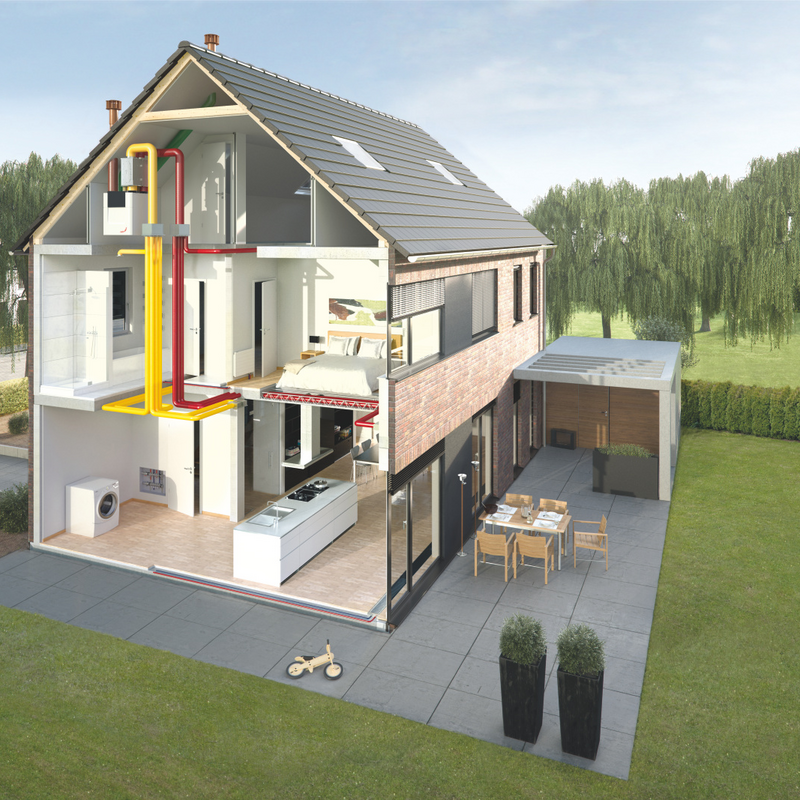
Recuperation – what is it and how does it work? Heat recovery in mechanical ventilation systems.

Contemporary construction increasingly focuses on energy efficiency, comfort and indoor air quality. One of the key solutions that combines these needs is recuperation, i.e. mechanical ventilation with heat recovery. Although this topic is gaining popularity, many people still do not know exactly how mechanical ventilation works and why it is worth installing.

What is recuperation (also known as mechanical ventilation) and how does it work?

Recuperation is the process of recovering heat from exhaust air (removed from the building) and transferring it to the incoming air. This is possible thanks to a special device called a recuperator. Traditional gravity ventilation is based on the draught (air suction) generated by chimneys, but recuperation ensures a constant flow of fresh air and its filtration, while reducing heat loss and eliminating the need to open windows.

The recuperation system consists of a recuperator and a network of ventilation ducts. At its heart is a heat exchanger, in which stale air transfers its heat to fresh air without mixing with it.

How do heat recovery systems work in ventilation systems?

A recuperator is a device responsible for air exchange in a building and heat recovery. Outside air is sucked in, filtered and heated by air removed from inside the building. This process significantly reduces energy losses and improves the efficiency of home heating. Importantly, depending on the solution, the system can be equipped with a supply fan that regulates the flow and maintains the correct pressure in the ducts.

Depending on your needs, you can choose a decentralised recuperator, which is ideal for individual rooms such as bathrooms or bedrooms, or more complex systems tailored to the entire building.


There are also other solutions:

  • Recuperator for attics or lofts – used in single-family homes,
  • Recuperator in a technical room – a classic solution for larger systems,
  • Small recuperator – a compact version for flats,
  • Recuperator with moisture recovery – to ensure optimal air humidity levels.

The practical application of heat recovery – saving thermal energy.

Recuperation in a single-family home allows for significant savings in heating costs, improves air quality and eliminates the need for classic window vents. Thanks to it, residents enjoy better thermal comfort, and the system has a positive impact on the total energy demand of the building. We are increasingly encountering recuperation in flats and blocks of flats, where the use of decentralised recuperators not only allows for heat recovery, but also reduces the inflow of cold air in winter without interfering with the structure of the building.

For those planning recuperation in attics or single-storey houses, the system design can be individually adapted to the interior layout. Professional recuperation design is key to ensuring high efficiency and quiet operation of mechanical ventilation.


Installation of heat recovery ventilation – what to keep in mind.

The installation of a heat recovery system should be carried out by an experienced company, preferably during the construction or major renovation phase. These systems require proper duct placement and access to the heart of the system, i.e. the heat recovery unit itself.

The installation of a heat recovery system involves several stages: design, duct installation, equipment installation, and system commissioning and adjustment. It is worth investing in equipment from reputable manufacturers, such as Zehnder heat recovery units, to ensure reliability and high efficiency. We recommend solutions from the Zehnder ComfoAir Q and ComfoAir Flex series, which are efficient and quiet, ensuring proper ventilation of rooms and heat recovery while guaranteeing comfort for everyone in the vicinity.

It is also very important to replace the filters regularly, as they are responsible for the cleanliness of the air supplied to the interior.

Where should the recuperator be installed?

The choice of installation location depends on the type of system. A heat recovery unit for a flat is best placed in a utility room or in a suspended ceiling. In single-family homes, popular locations include utility rooms, attics or lofts. For those with limited space, a small recuperator that fits in a wall cabinet or recuperators that can be installed without the need for ductwork are ideal solutions.